My Dad, an Apple IIe and a Stack of Nibble Magazines
My dad bought an Apple IIe and a stack of Nibble Magazines. This was the start of my career in computer graphics.
Ben Houston • • 4 min read
Everyone has a story about how they ended up in their current career. Mine starts with my dad, an Apple IIe, and a stack of Nibble Magazines.
My Dad and His Love of Computers#
My father spent his career as an electronics technician, first with the Canadian Air Force, then later with Transport Canada, maintaining the test equipment used to validate landing computers at airports. He got into that career because he was interested in electronics and had been doing Heathkit hobbyist projects since the 1970s. It makes sense that when home computers became a reality, he was one of the first to bring one home.
In 1985, he bought us an Apple IIe with I think most of the available peripherals (80 column card, 3.5" disk, dual 5.25" disk drives, a mouse and a modem). It was an expensive investment at the time, somewhere around
10K in 2026 dollars. He also built up a book library to go with it: books published by Nibble Magazine collecting their best one- and two-liners, and a running subscription to Nibble Magazine itself. He showed me a bit of AppleSoft BASIC to get me started. While it was his computer, he let me have free range of it.
Learning to Code From Nibble#
Nibble was magical. My Dad learned about it at the local Vancouver Apple II user group. The books and magazine issues were packed with small programs you could type in, little demos that fit in two lines of BASIC. Two hundred fifty-five characters per line, maximum. To make the most of that constraint, you packed in compound statements, used exponential notation tricks like 9E9 to create an infinite loop, and used shorthand tricks. For an aspiring nerd like me, it was entertainment disguised as a masterclass in optimization and ingenuity.
Nibble itself had started in 1980 in Mike Harvey's living room as a newsletter for Apple II owners. It promised to "Nibble Away" at the mysteries of the Apple II for beginning and advanced programmers alike, and it kept that promise for more than a decade. Its pages mixed games, graphics, utilities, BASIC, assembly language, and well-commented listings that made the tricks visible. For a kid trying to understand what computers could do, those listings gave me something I could copy, run, break, and rebuild.
My dad didn't have much spare time, but I did. I had the machine, the books, the magazines, and the obsession. I typed in most of the one and two liners from those books and magazines, studying each one as I did. I remember modifying them to make them do new things as soon as I had them working the way they were supposed to work. This is how I learned programming at around the age of 8: by studying small digestible bits of source code and modifying them to do other things.
The Fireworks Two-Liner#
It encouraged me to create dozens of little experiments. I remember re-creating a Galton board using the hires mode (recreating the Gaussian distribution via simulation), a working breakout game using the high color mode, Zork-like choose your own adventure games, and my own BBS menu software. My fascination with Nibble culminated when I submitted my own creation to their monthly Nibble's one- and two-liner contest and won. It was a fireworks screensaver. Nibble published it in the June 1990 issue, just a couple of months before my twelfth birthday.
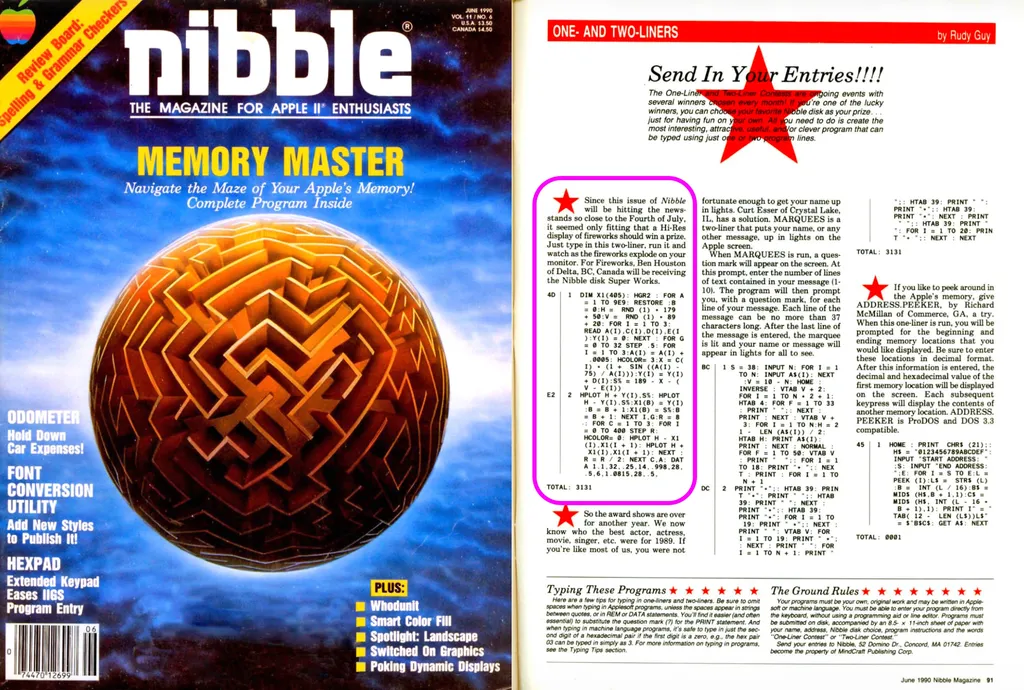
My fireworks entry as it appeared in the June 1990 issue of Nibble Magazine.
The program simulated a firework: fragments radiating outward from a random location in arcs, then fading. I worked out that sine functions traced the right kind of curves for the trajectories, so I cut up arcs from those curves to create the fireworks and then built a sine lookup table to make it fast enough for real-time animation. I tried to get in the initial shell rising into the sky before the explosion, but I couldn't fit it in with the size constraints.
10  DIM X1(405): HGR2: FOR A = 1 TO 9E9: RESTORE: B = 0: H = RND(A) * 119 + 50:
    V = RND(A) * 89 + 28: FOR I = 1 TO 3: READ A(I), C(I), D(I), E(I): Y(I) = 0:
    NEXT I: FOR G = 0 TO 32 STEP .5: FOR I = 1 TO 3: A(I) = A(I) + .0005: HCOLOR
    = 3: X = C(I) * (1 + SIN((A(I) - 75) / A(I))): Y(I) = Y(I) + D(I): S% = 189
    - X - (C(I) - E(I))
20  HPLOT H + Y(I), S%: HPLOT H - Y(I), S%: X1(B) = Y(I): B = B + 1: X1(B) = S%:
    B = B + 1: NEXT I: NEXT G: R = B: FOR C = 1 TO 3: FOR I = 0 TO 400 STEP R:
    HCOLOR = 0: HPLOT H - X1(I), X1(I + 1): HPLOT H + X1(I), X1(I + 1): NEXT I:
    R = R / 2: NEXT C: NEXT A : DATA 1, 1, 32, .25, 14, .998, 28, .5, 6, 1,
    .0015, 20, .5
In retrospect, the equations of motion would have matched the physics better. But I didn't know them yet. Sine looked right, so sine it was.
What It Gave Me#
My dad and Nibble Magazine taught me to learn by doing, one small program at a time. Each listing taught one new trick in a form I could understand and change. My parents were supportive, willing to come down to the basement to see the latest creation I had made on the computer. Winning the contest made programming feel like something I could keep pursuing, with computer graphics at the center. My career in computer graphics started with my Dad, the Apple IIe, and Nibble Magazine.